The OPWA list: BRL 9320 and NL BSB for asphalt additives

Asphalt falls under the Dutch Soil Quality Decree; an additive must be environmentally approved. The OPWA list governs that — AsphaltX® is on it, with a maximum of 0.1% and reassessment until 2031.
The OPWA list (Omschrijving Productgroep Warm Asfalt — Description of the Warm Asphalt Product Group) sets out, per constituent material, the maximum quantity in which it may be applied safely in hot asphalt from an environmental soil quality perspective under the NL BSB® certificate based on BRL 9320. Listed additives require no additional leaching research; AsphaltX® is on the list with a maximum of 0.1% and reassessment until mid-2031.
What is the OPWA list?
Asphalt is more than stone and bitumen. Fillers, rejuvenators, pigments and fibres help determine the performance of the mix — but may not simply be applied at will. The OPWA — in full Omschrijving Productgroep Warm Asfalt — is the document that sets out, per constituent material, the quantity in which it can be safely processed in hot asphalt, for both shaped (V) and non-shaped (N) construction materials such as porous asphalt (ZOAB).
The list is maintained by the Centrale Organisatie TOP and is based on environmental analyses of asphalt mixes from 1999 to the present day. For each category — aggregate, sand, bitumen, filler, additives and pigments — the OPWA gives a maximum applicable percentage and a reassessment date. The current version can be found in the downloads section at top-advies.nl.
If an additive is not on the list, environmental research is required on an asphalt mix containing that material before it may be produced under NL BSB. For asphalt additives such as fibres, the OPWA listing is therefore effectively the ticket of admission to Dutch asphalt production.
Soil Quality Decree, BRL 9320 and NL BSB: how they fit together
Three concepts circulate around asphalt that are often confused. Together they form a single system, from legal basis to practical proof:
• Soil Quality Decree (Besluit bodemkwaliteit) — the legal basis. Since its introduction in 2008, anyone applying a stony construction material such as asphalt must be able to demonstrate that it is environmentally safe: no harmful substances may leach into soil and groundwater above the standard values.
• BRL 9320 — the assessment guideline for bitumen-bound mixes (asphalt and asphalt granulate). It describes what production and composition must comply with and how the certification body verifies this.
• NL BSB® product certificate — the means of proof. An asphalt producer holding an NL BSB certificate based on BRL 9320 thereby demonstrates that its mixes comply with the Soil Quality Decree; the buyer then no longer needs to carry out a batch inspection.
Within this system, the OPWA list is the working document: it translates the certification framework into concrete construction materials and maximum dosages, so the asphalt plant knows per mix what is permitted.
Why this matters to asphalt plants
For an asphalt plant, the OPWA list is in practice the fastest route to certainty. An additive that is on the list can be dosed within the stated range without additional leaching research — the homework has already been done. That saves lead time, research costs and discussion with the certification body.
The listing is also relevant to clients and specification writers: they know that a mix with an OPWA-listed additive simply falls under the producer's NL BSB certificate. Anyone tendering fibre-reinforced asphalt can therefore include the OPWA listing of the specified fibre as a simple verification question in the specification — one line that prevents a great deal of investigation afterwards.
The reverse also applies: if a specification prescribes an additive that is not on the list, the environmental research shifts to the execution phase — with the associated risk to the schedule and budget of both producer and client.
Additive not on the OPWA list — what then?
A new or unknown additive is not prohibited by definition; there is simply a research route before production under NL BSB is possible. In broad terms, that route looks like this:
• Step 1: composition check — the producer records which substance is involved, at which dosage and in which mix types (N and/or V construction materials) it is applied.
• Step 2: trial mix — a representative asphalt mix is produced in which the additive occurs at the intended (maximum) dosage.
• Step 3: leaching research — an accredited laboratory determines via composition and leaching tests whether the mix stays within the standard values of the Soil Quality Decree.
• Step 4: assessment and listing — if the results fall within the limits, the additive can be included in the OPWA with a maximum percentage and a reassessment date; every NL BSB-certified plant may then use it within that range.
Allow months rather than weeks for this process: laboratory research, assessment and publication take time. For a supplier of asphalt additives, it therefore pays to have the listing arranged in advance — exactly why we have done this for our aramid asphalt fibre and maintain the status.
AsphaltX® is on the OPWA list
AsphaltX® is included in the OPWA as an environmentally approved asphalt fibre. The listing at a glance:
• Category — additives.
• Maximum applicable percentage — 0.1% in both N and V construction materials (equivalent to 1 kg per tonne of asphalt).
• Reassessment — runs until mid-2031, longer than many other additives on the list.
• Mix types — porous asphalt (ZOAB), SMA and dense asphalt alike.
Our recommended dosage of around 500 grams per tonne of asphalt — roughly 0.05%, depending on mix and application — sits comfortably within that maximum. Asphalt plants can therefore process AsphaltX® in their NL BSB-certified mixes without additional environmental research and without changing the recipe.
The OPWA listing does not stand alone, incidentally: the fibre is based on Twaron® aramid with European production under ISO 9001. You will find an overview of all certificates and declarations on our certificates page.
Environmental soil quality is not the same as environmental performance
Finally, a distinction that quite often goes wrong in specifications. The OPWA list and the NL BSB certificate concern environmental soil quality: does the mix leach no harmful substances into soil and water? They say nothing about environmental performance — the CO₂ emissions and environmental costs (MKI) over the life cycle of the asphalt.
For the latter there is a separate framework: life cycle assessments according to the PCR Asphalt, the calculation rules for the environmental performance of asphalt mixes, and for fibre products additional sustainability certification of fibre materials. A complete specification for fibre-reinforced asphalt therefore calls for both: an OPWA-listed additive (environmental soil quality) and a substantiated MKI value (environmental performance).
You will find more background on the technology, mixes and practical projects in our overview of fibre-reinforced asphalt.
Getting started with fibre-reinforced asphalt?
Want to know what fibre reinforcement means for your mix or project? Visit the AsphaltX® product page with the datasheet and reference projects such as the N337, or request a quotation for dosage advice and specification texts — including the wording of the OPWA/NL BSB requirement for your specification.
Frequently asked questions
- What is an NL BSB certificate?
- NL BSB® is a product certificate demonstrating that a stony construction material — such as asphalt — meets the environmental requirements of the Dutch Soil Quality Decree. For asphalt, BRL 9320 is the underlying assessment guideline. A buyer of NL BSB-certified asphalt no longer needs to carry out a batch inspection; the producer's certificate serves as legal proof.
- Is the OPWA list mandatory?
- The list itself is not law, but the practical working document within NL BSB certification based on BRL 9320. An asphalt producer may also use additives outside the list, but must then first demonstrate via leaching research that the mix complies with the Soil Quality Decree. An OPWA-listed additive within the maximum percentage does not require that research.
- Does the OPWA list also apply to fibres in asphalt?
- Yes. Fibres fall under the additives category and therefore, just like fillers and pigments, need a listing with a maximum percentage and a reassessment date. AsphaltX® is included as an aramid asphalt fibre with a maximum of 0.1% (1 kg per tonne) in N and V construction materials, comfortably above the recommended dosage of around 500 grams per tonne.
- What do N and V construction materials mean in the OPWA?
- The Soil Quality Decree distinguishes shaped (V) and non-shaped (N) construction materials. Dense asphalt counts as shaped; open mixes such as porous asphalt (ZOAB) as non-shaped, with stricter leaching requirements because water flows through them more easily. The OPWA states the maximum applicable percentage for both categories per construction material.
- Where can I find the current OPWA list?
- The OPWA is maintained by the Centrale Organisatie TOP and updated periodically; the current version is in the downloads section at top-advies.nl. When writing a specification, always check the latest version: maximum percentages and reassessment dates can change. The reassessment of AsphaltX® runs until mid-2031.
Share this article
Products mentioned
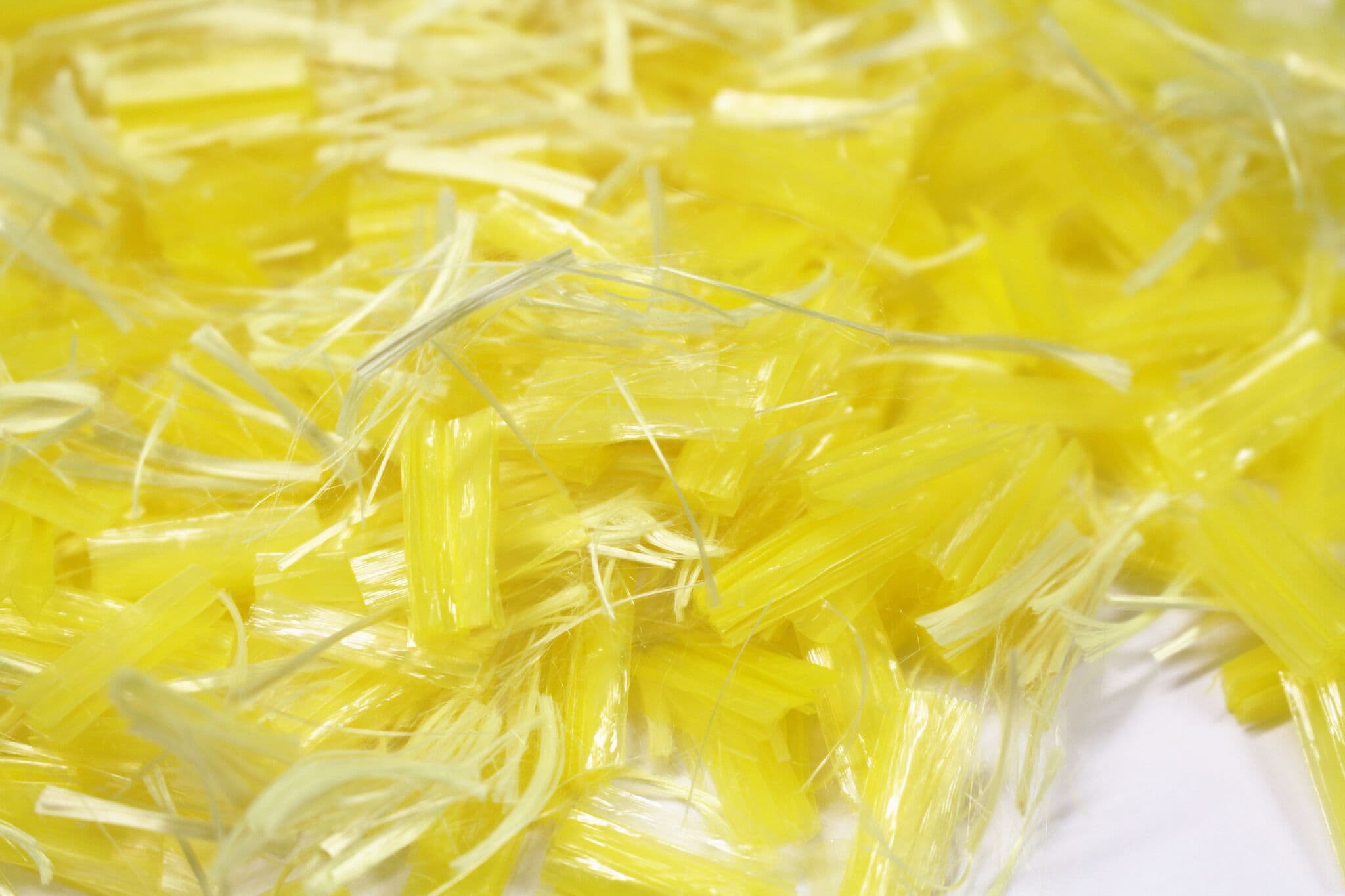
AsphaltX®
2000 filaments per aramid strand — 19 million fibres per tonne of asphalt. Lowest CO₂ footprint, European manufacturing, proven on the N337.
- TypeAramid (Twaron®) + polyolefin fibre blend
- Length± 19 mm
- Tensile strengthTwaron 3000 MPa · polyolefin 483 MPa
- Specific gravityTwaron 1.45 · polyolefin 0.91 g/cm³