Help validate the asphalt of the future

Fibre-reinforced asphalt is proving itself in practice; now it is objective data's turn. Dutch Fiber Trading is looking for validation sections with road authorities and contractors — this is what such a section involves and what you get in return.
A validation section is a regular stretch of road in which fibre-reinforced asphalt is monitored under real traffic loading with objective asphalt research: core samples, falling weight deflection measurements, CPX noise measurements and visual inspections. Dutch Fiber Trading is looking for road authorities and contractors willing to build such a section. On the A73 this approach has already proven that aramid fibres match the performance of PMB at a roughly 15–20 °C lower production temperature.
Why additional asphalt research is needed
Dutch infrastructure faces a substantial challenge. Roads must last longer, maintenance budgets are under pressure, and at the same time there is a growing need to reduce CO₂ emissions and raw material use — and to cut the number of asphalt mixtures. Extensive international research has been carried out into aramid fibres in asphalt, with demonstrated positive effects on rutting, cracking and service life. In the Netherlands too, various roads, roundabouts and trial sections have now been realised with fibre-reinforced asphalt.
Practical experience has been positive. On the N337 between Zwolle and Deventer, monitoring across 8 kilometres of fibre-reinforced road surface showed 50% less rutting and 30% less cracking than the reference section, with an expected service life around 30% longer. Visual inspections and regular monitoring at other locations confirm that the structures are holding up well.
Now it is time to substantiate those experiences further with objective measurement data. Not only to confirm performance, but above all to:
• predict service life more accurately and plan maintenance measures better;
• optimise structures and reduce the number of asphalt mixtures required;
• make sustainability gains (MKI and CO₂ reduction) visible in figures;
• support clients in making well-founded investment and tendering decisions.
For this we are seeking collaboration with municipalities, provinces, water boards, Rijkswaterstaat, contractors, asphalt producers and knowledge institutes.
What is a validation section?
A validation section is an asphalt trial section built within regular maintenance or new construction, alongside a reference section in the same mixture but without fibres. Both sections receive the same traffic loading, subgrade and weather — the only difference is the fibre. Any measured difference can therefore be attributed directly to the fibre reinforcement.
The difference from a classic trial section lies in the measurement programme. Where a trial section is often only monitored visually, a validation section comes with a defined measurement plan including a baseline measurement and periodic follow-up measurements. This produces a dataset that makes the validation of the pavement usable and verifiable for third parties too — structural engineers, contracting authorities, knowledge institutes.
No special equipment is needed for the construction itself. The fibre — for example AsphaltX® based on Twaron® aramid — is added to the mixer at the asphalt plant at an indicative dosage of around 0.05%, or roughly 500 grams per tonne of asphalt, depending on mixture and application. Production and paving equipment remain unchanged.
What the measurement programme looks like
The measurement plan is tailored per project to the road type and the research question, but rests on four fixed pillars.
Baseline measurement at construction
During and directly after construction, the production temperature, compaction, layer thickness and evenness are recorded, together with the mixture data from the plant. This baseline measurement is the reference point against which all follow-up measurements are set.
Core samples and laboratory research
Asphalt research using core samples reveals what is happening inside the structure. Cores are drilled from the validation and reference sections for laboratory tests: stiffness, fatigue resistance, indirect tensile strength and moisture sensitivity. By repeating this at construction and after a few years, the ageing of both sections is mapped comparably. Core holes are repaired immediately; traffic disruption is limited to a short closure.
Measurements on the road: deflection, noise and inspection
• Falling weight deflection measurement (FWD) — measures the bearing capacity and stiffness of the structure without damaging the road; the most important instrument for calculating residual service life.
• CPX noise measurement — records the noise performance of the road surface; on the A73 the aramid mixture proved exactly equivalent to the PMB reference at 91.3 dB(A).
• Visual inspection — annual recording of ravelling, cracking and rutting according to standard road management practice, so the data ties in with your existing management system.
• Evenness and skid resistance — longitudinal evenness and scuffing resistance, the same parameters monitored in Rijkswaterstaat's regular monitoring programme.
Duration and measurement moments
A validation section typically runs for five years: a baseline measurement at construction and follow-up measurements after one, two and five years. That matches the set-up of the FIBRA research, where the test sections are monitored long-term with video inspections in year 2 and year 5. Interim results are shared after each measurement round, so you do not have to wait five years for the first insights.
Who does and pays for what?
The division of roles is essentially simple. The road authority or contractor contributes a suitable road section — a maintenance section or new-build alignment that is already scheduled — and builds it within the regular works. Dutch Fiber Trading supplies the fibre, provides the dosing advice to the asphalt plant and coordinates the measurement programme, where useful together with an independent laboratory or knowledge institute.
The additional construction costs are thereby limited to the fibre itself; the FIBRA business case shows that fibre reinforcement can be cost-neutral compared with PMB in the Dutch situation, provided a comparable service life is achieved. The precise division of measurement costs and data ownership is laid down per project in the measurement plan — all results are free for the participating road authority to use.
What do you get back as a road authority?
Participation delivers more than a reinforced stretch of road. You receive an objectively substantiated dossier on your own network:
• Substantiated service-life extension of your asphalt — measurement data with which you can stretch maintenance intervals and calculate the business case for your next programme;
• Tendering ammunition — validated MKI and performance data that you can use directly in functional specifications and EMVI tenders;
• A knowledge advantage — results are shared with the sector, and your organisation is on the map as a front-runner.
For municipalities, a validation section is moreover a low-threshold way to explore fibre reinforcement in their own road management without overhauling the entire network at once; for provinces it ties in with the way innovations are procured through tenders.
The A73 as precedent
That this approach works has already been proven. Within the European FIBRA project, BAM and Rijkswaterstaat built a trial section on the A73 near Roermond in August 2020 — a trunk road carrying around 50,000 vehicles per working day. Four mixtures were laid side by side: a PMB reference, a reference with cellulose fibre, a PAN fibre mixture and an aramid mixture with Twaron 1080.
The outcomes: the aramid mixture was produced at around 165 °C versus 181 °C for the PMB reference, performed equivalently in the field measurements on scuffing resistance, water drainage, noise and evenness, and scored more than 10% lower on the environmental cost indicator (MKI) at cradle-to-gate level. All details are in the case study of the FIBRA research on the A73.
The A73 thereby answered the question of whether fibre-reinforced asphalt performs on a heavily loaded trunk road. The validation sections we are now looking for build on that: more road types, more mixtures, longer measurement series — the dataset needed to sharpen service-life models and MKI calculations for the entire sector.
Registering a validation section
Does your organisation have a maintenance section, roundabout or new-build alignment where a validation section would fit? The practical threshold is low: construction runs within the regular works, we agree the measurement plan with you in advance, and the results are yours.
Get in touch to discuss the possibilities for your network — together we will measure, monitor and prove what the asphalt of the future is worth.
Frequently asked questions
- What is the difference between a trial section and a validation section?
- An asphalt trial section is often only monitored visually. A validation section additionally has a defined measurement plan with a baseline measurement, a reference section without fibres and periodic measurements: core samples, falling weight deflection, CPX noise and visual inspection. Any measured difference can thereby be objectively attributed to the fibre reinforcement and used for tenders and service-life calculations.
- How long does the monitoring of a validation section run?
- Typically five years: a baseline measurement at construction and follow-up measurements after one, two and five years. That matches the FIBRA research on the A73, where video inspections are scheduled in year 2 and year 5 alongside the regular annual monitoring programme. Interim results are shared with the participating road authority after each measurement round.
- What does participation in a validation section cost?
- Construction runs within regular maintenance or new construction; the additional costs sit mainly in the fibre itself. The FIBRA business case shows that fibre reinforcement can be cost-neutral compared with PMB, provided a comparable service life is achieved. The division of measurement costs is laid down per project in the measurement plan; get in touch to discuss the options.
- Which measurements belong to asphalt research on a validation section?
- Four pillars: core samples for laboratory research into stiffness, fatigue and moisture sensitivity; falling weight deflection measurements for bearing capacity and residual service life; CPX measurements for noise; and annual visual inspection of ravelling, cracking and rutting. Supplemented with evenness and skid resistance, this gives a complete picture of performance under real traffic loading.
- Does the asphalt plant have to adjust the mixture for a validation section?
- No. An aramid fibre such as AsphaltX® is added to the mixer at the plant at an indicative dosage of around 0.05% — roughly 500 grams per tonne, depending on mixture and application. Mix design, production and paving equipment remain unchanged; on the N337 and the A73 this was processed without modifications.
Share this article
Products mentioned
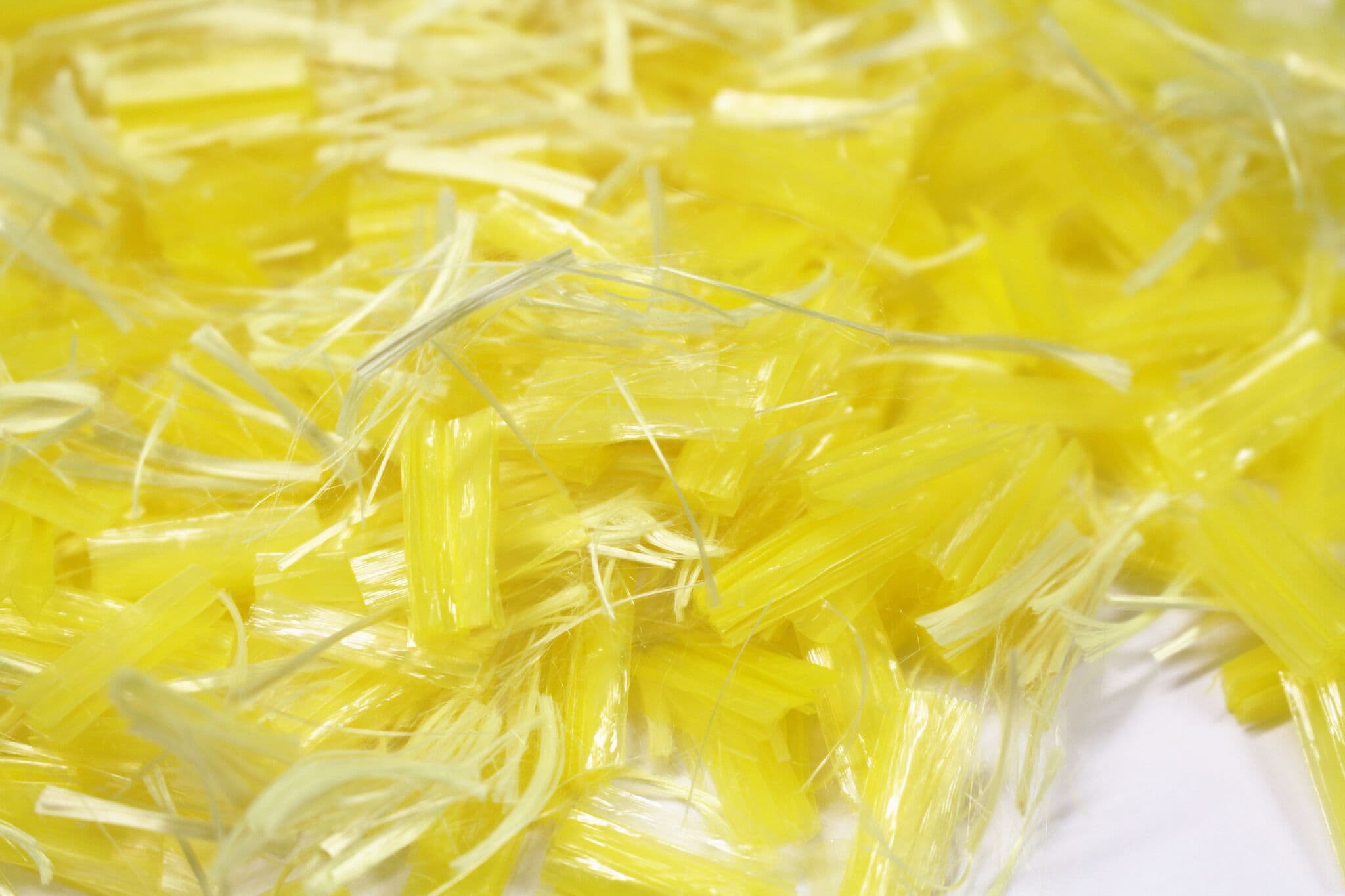
AsphaltX®
2000 filaments per aramid strand — 19 million fibres per tonne of asphalt. Lowest CO₂ footprint, European manufacturing, proven on the N337.
- TypeAramid (Twaron®) + polyolefin fibre blend
- Length± 19 mm
- Tensile strengthTwaron 3000 MPa · polyolefin 483 MPa
- Specific gravityTwaron 1.45 · polyolefin 0.91 g/cm³