EMVI tendering: meaning, criteria and how to score on sustainability


EMVI decides who wins public works in the Netherlands: not the lowest price, but the best price-quality ratio. This is how the notional discount works — and how you score on the sustainability criteria.
EMVI stands for Economisch Meest Voordelige Inschrijving — the Dutch equivalent of the Most Economically Advantageous Tender (MEAT): awarding on the best combination of price and quality rather than the lowest price alone. Since the 2016 Public Procurement Act, the common variant is formally called BPKV. Quality is settled as a notional discount on the tender price — a CO₂ Performance Ladder level alone can be worth around 10% award advantage.
What does EMVI mean?
EMVI is the abbreviation of Economisch Meest Voordelige Inschrijving (Most Economically Advantageous Tender). It is the award methodology under which a contracting authority — Rijkswaterstaat, a province, water board or municipality — does not simply pick the cheapest bidder, but the tender with the best ratio between price and quality. Quality criteria such as sustainability, service life, nuisance reduction and risk management are given a weighting published in advance and count towards the award decision.
The methodology is the answer to an old problem in construction: whoever awards on lowest price alone rewards sharp calculation and gets the quality that comes with it. The Dutch Public Procurement Act 2012 therefore made awarding on EMVI the statutory default — awarding on lowest price is only permitted with justification ("comply or explain"). For the civil engineering (GWW) sector, this means that virtually every substantial works contract is now assessed on price and quality. This article is the starting point of our tendering cluster within the pillar sustainability, standards and innovation.
EMVI or BPKV: what about those terms?
When the Public Procurement Act was revised in 2016 (implementing the European procurement directive), the terminology shifted. EMVI has since been the umbrella term for three award criteria: the best price-quality ratio (BPKV), the lowest cost calculated on the basis of cost-effectiveness (such as life-cycle costs), and the lowest price. So what was called "EMVI" before 2016 is now formally BPKV.
In day-to-day civil engineering practice, EMVI and BPKV are used interchangeably for the same principle: weighing quality via a notional discount on the tender sum. In specifications, tender portals and conversations with clients you will encounter both terms; there is no substantive difference. In this article we use the established term EMVI.
How an EMVI tender works
In broad terms, an EMVI tender proceeds as follows: the client publishes the request with the award criteria and their weighting, bidders submit a quality document alongside their price (the EMVI plan), an assessment panel rates that plan per criterion — usually with marks according to a pre-published assessment framework — and the scores are converted into a monetary value.
That conversion is the heart of the methodology: the quality value is deducted from the tender price as a notional discount. The contract is awarded on the lowest *evaluation price* — tender price minus notional discount — while the winner simply invoices their actual tender price. Quality thus literally becomes worth money, without the client paying more than the price offered. In the civil engineering sector this method is also known as "awarding on value", after the CROW publication of the same name.
Worked example: notional discount and evaluation price
A fictitious but representative example of an EMVI award with two bidders on a provincial asphalt contract:
• Bidder A — tender price €1,000,000; strong quality score (low ECI, ladder level 5, well-crafted stakeholder plan) worth €120,000 notional discount; evaluation price €880,000.
• Bidder B — tender price €950,000; average quality score worth €40,000 notional discount; evaluation price €910,000.
• Outcome — bidder A wins, despite a €50,000 higher price: the €80,000 quality difference is decisive.
The EMVI score is therefore not a stand-alone mark, but an amount that competes directly with the price. The heavier quality weighs in the request — 20 to 50% of the notional value is common in civil engineering — the more a good plan can bridge a price difference.
Commonly used EMVI criteria for sustainability
The award criteria differ per tender, but in infrastructure requests a fixed core of EMVI criteria around sustainability has crystallised:
• ECI score with a cap value — the bidder calculates the Environmental Cost Indicator (MKI) of their design in DuboCalc; the further below the reference value, the larger the notional discount. How that calculation works is explained in ECI and DuboCalc explained.
• CO₂ Performance Ladder level — a fixed discount percentage per certification level, rising to around 10% at level 5. See the CO₂ Performance Ladder and fibre reinforcement.
• Service life and low maintenance — longer warranty or design life and fewer maintenance interventions over the contract period.
• Circularity — share of reused material (asphalt granulate, concrete granulate) and recyclability at end of life.
• Stakeholder management and nuisance reduction — shorter closures, phasing plan, communication with residents and businesses.
• Risk management — a risk file with control measures for the specific project risks.
One common thread runs through the sustainability criteria: the client wants verifiable figures, not ambitions. That is precisely why material choices substantiated with EPDs, certificates and independent research pay off.
How you score as a contractor with fibre reinforcement
For tendering contractors, fibre reinforcement of concrete and asphalt is one of the few measures that scores points on several EMVI criteria at once — with figures an assessment panel can check.
In concrete, a structural macro fibre replaces (part of) the traditional steel reinforcement. At the NDSM wharf in Amsterdam, that switch delivered a 98% CO₂ reduction on the reinforcement — a claim you can substantiate in DuboCalc with an NMD-compliant calculation, because a fibre such as TwistR® counts in kilograms per m³ where steel runs into tens of kilograms. Note: structural work always requires a calculation by the structural engineer; fibres do not fully replace reinforcement in every application.
In asphalt, an aramid fibre as a distinguishing EMVI criterion acts on three criteria at once. The dosage is modest — indicatively around 0.05%, or some 500 grams per tonne, depending on mix and application — but the effect is documented: within the European FIBRA programme (A73 trial section), the aramid variant with standard penetration bitumen proved to have an ECI more than 10% lower than the PMB reference mix, partly due to the production temperature being around 15-20 °C lower. On the provincial N337, fibre reinforcement delivered 50% less rutting and an expected service life around 30% longer — direct gains on the service-life criterion.
How you translate those figures into a winning quality document — including a sample passage for your EMVI plan — is covered in the article on fibre reinforcement for contractors and the EMVI plan. The essence: write project-specific, verifiable commitments, not sector averages — and promise nothing you cannot deliver on site, because unfulfilled EMVI promises usually carry a penalty clause.
For clients: formulating EMVI criteria
On the other side of the table, the quality of the criteria determines the quality of the tenders. Three principles have proven themselves in civil engineering:
• Specify functionally — ask for performance (service life, ECI cap, rutting resistance), not brand names or recipes. That keeps the request open to innovation and prevents one supplier from being prescribed de facto.
• Make criteria measurable — a criterion the assessment panel cannot test objectively invites dispute and litigation risk. Link every criterion to a calculation method (DuboCalc), a certificate (ladder level) or a measurable performance requirement.
• Announce verification in advance — make transparent in the request how claims will be checked after award and what sanction applies to deviation.
How provinces put this into practice — including a sample set of award criteria for an asphalt contract — is covered in how provinces tender sustainable roads. A practical checklist with sample specification text and a worked-out EMVI award criterion can be found in tendering fibre-reinforced asphalt: what to look for.
EMVI performance measurement: holding on to the promise after award
An EMVI commitment is only worth something if it is kept. That is why quality-based awarding comes with EMVI performance measurement: during execution, the client periodically checks whether the promised quality is actually being delivered — ECI verification on delivered mixes, checks on production temperatures, condition measurements on the completed work. If performance falls short, a pre-announced deduction follows, usually linked to (part of) the notional EMVI advantage from the tender. For bidders that is not a threat but a filter: whoever bases claims on documented field results rather than paper promises has nothing to fear from performance measurement.
From tender to award advantage
EMVI rewards those who can prove quality. For contractors that means: build up a file of reusable, verified claims — EPDs of the materials used, project-specific CO₂ and ECI calculations, documented field results — and deploy that file again with every tender. Fibre reinforcement supplies some of the hardest figures in the sector: up to 98% CO₂ reduction on the reinforcement in concrete and more than 10% ECI gain in asphalt.
Tendering for an EMVI request soon? Request a quotation with EPD and dosage documentation — and you will have the environmental figures for your DuboCalc calculation and quality document right at hand.
Frequently asked questions
- What does EMVI mean?
- EMVI stands for Economisch Meest Voordelige Inschrijving — the Dutch Most Economically Advantageous Tender: awarding on the best combination of price and quality rather than the lowest price alone. Quality criteria such as sustainability, service life and nuisance reduction are rated by an assessment panel and converted into a notional discount on the tender price. The tender with the lowest evaluation price — price minus discount — wins the contract.
- What is the difference between EMVI and BPKV?
- Since the revision of the Dutch Public Procurement Act in 2016, EMVI has been the umbrella term for three award criteria: best price-quality ratio (BPKV), lowest cost based on cost-effectiveness, and lowest price. BPKV is the formal name for what used to be called EMVI: awarding on price and quality. In civil engineering practice, both terms are used interchangeably for the same principle.
- How is an EMVI score calculated?
- An assessment panel rates the quality document per award criterion, usually with marks according to a pre-published assessment framework. Those scores are converted into a monetary amount: the notional discount. The contract is awarded on the evaluation price — tender price minus notional discount — while the winner invoices their actual price. Objective criteria such as an ECI calculation in DuboCalc are calculated through directly.
- What goes into an EMVI plan?
- An EMVI plan is the quality document submitted with the tender: per award criterion, the contractor describes concretely and verifiably what they commit to — for example an ECI value, a CO₂ reduction on the reinforcement or a nuisance-reducing phasing — including evidence and verification moments. A sample passage and writing tips can be found in our article for contractors.
- Is awarding on EMVI mandatory?
- The Dutch Public Procurement Act makes awarding on the best price-quality ratio the default: contracting authorities may only deviate with justification and award on lowest price ("comply or explain"). In civil engineering practice, the majority of substantial works are therefore awarded on EMVI/BPKV, almost always with sustainability criteria such as an ECI cap or a CO₂ ladder level.
- How does sustainability count in an EMVI tender?
- Through measurable criteria: an ECI cap with a DuboCalc calculation, a fixed discount percentage per level on the CO₂ Performance Ladder (up to around 10% at level 5), and service-life and circularity requirements. Material choices with verified environmental data score directly: in a documented case, fibre reinforcement delivered a 98% CO₂ reduction on the reinforcement and more than 10% ECI gain in asphalt.
Products mentioned
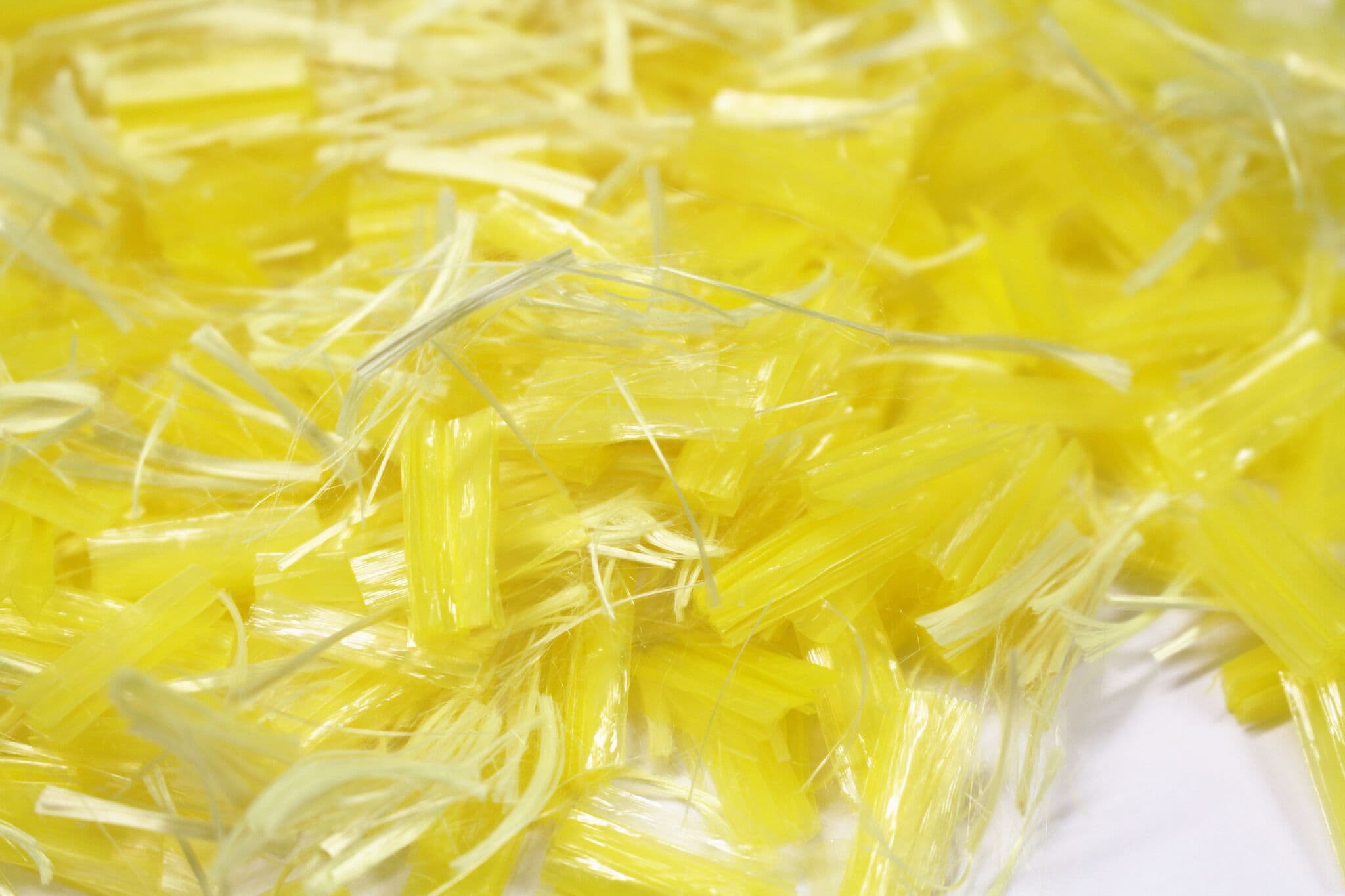
AsphaltX®
2000 filaments per aramid strand — 45% more than competitors. Lowest CO₂ footprint, European manufacturing, proven on the N337.
- TypeAramid (Twaron®) + polyolefin fibre blend
- Length± 19 mm
- Tensile strengthTwaron 3000 MPa · polyolefin 483 MPa
- Specific gravityTwaron 1.45 · polyolefin 0.91 g/cm³
 Most chosen
TwistR® GREEN HYBRID
High-performance synthetic macro fibres made from 100% polypropylene. Transforms concrete into a stronger composite material.
- TypeHybrid: twisted monofilament + fibrillating network fibre
- Material100% virgin polypropylene
- Length48 mm
- Dosage2.0 – 6.0 kg/m³
Pallet price on request