Fibre reinforcement for contractors: site benefits and your EMVI plan

Fibre reinforcement saves contractors an entire reinforcement work stage and delivers hard figures for the EMVI quality plan: lower ECI, less CO2 and an asphalt mix produced at lower temperature.
Fibre reinforcement delivers a double benefit to contractors in road construction and civil engineering. On site, the entire reinforcement work stage disappears — indicatively 40 to 80 man-hours per 1,000 m² of floor area. And in the EMVI plan (the quality document in a Dutch best price-quality tender) it delivers claims you can substantiate: over 10% lower ECI, a 15-20°C lower production temperature for asphalt, and up to 98% CO2 reduction on the reinforcement component.
Why fibre reinforcement pays off in road construction and civil engineering
For an infrastructure contractor, fibre reinforcement has long ceased to be a sustainability story for show. Public clients award the majority of their works on EMVI — formally the best price-quality ratio (BPKV), the Dutch implementation of the Most Economically Advantageous Tender — where sustainability, ECI and CO2 sit alongside price as quality criteria. Anyone tendering in road construction or the wider civil engineering sector therefore has two reasons to take fibres seriously: they save money and hours in execution, and they provide distinctive, verifiable material for the quality document submitted with the bid.
This article looks at both sides from the perspective of the executing party; it is part of our pillar on applications and target groups. What EMVI means exactly, how award criteria and notional discounts work and how assessment panels score, is covered in the article on EMVI tenders: meaning and criteria. Here we address the question that comes next: what do you, as the contractor writing the plan, put in it — and how do you deliver on it on site?
Site benefits: what do you actually save?
The gains from fibre reinforcement start not at the tender, but in execution. Four items weigh heaviest.
Fewer labour hours, shorter lead time
The most direct benefit: the separate work stage of delivering, cutting to size, positioning and anchoring reinforcement mesh disappears entirely. Fibres arrive ready-dosed from the concrete mixer. As a practical rule of thumb, laying and tying reinforcement mesh quickly costs 40 to 80 man-hours per 1,000 m² of floor area, depending on mesh weight, laps and detailing around penetrations and edges — hours that simply do not exist with fibre concrete. On large floor areas and road projects, that adds up to days of shorter lead time, less plant hire and earlier handover.
A full comparison of the cost build-up of both methods can be found in fibre concrete versus reinforcement mesh: time and costs. Want to know what this means for your own project? Calculate your labour saving with our calculator.
Lower failure costs
Failure costs in construction are estimated in industry studies at some 5 to 13% of turnover. Incorrectly positioned or insufficiently anchored reinforcement — mesh sunk too low in the cross-section, forgotten spacers, insufficient lap — is a classic item within that, including the subsequent dispute with the client. With fibre reinforcement, that source of error does not exist: the fibres are homogeneously distributed throughout the entire mix, from underside to top layer. There is nothing to position incorrectly.
Better workability, including in awkward spots
The field trials within the European FIBRA project on the A73 showed that fibre-reinforced asphalt mixes (with aramid or PAN fibre) are easier to work by hand than mixes with polymer modified bitumen (PMB) — relevant at tie-ins, bends and smaller areas that cannot be laid by machine. Fibre clusters or installation problems were not observed in those trials. This is also of interest for temporary paving on the site itself: see fibre-reinforced asphalt for heavy and temporary haul roads.
Flexibility with complex shapes
In concrete, fibre reinforcement makes shapes and structures feasible that would be highly labour-intensive or practically unthinkable with traditional steel fixing — double-curved elements, narrow recesses, non-standard foundations. For contractors executing non-standard designs, that means less bespoke reinforcement work and less risk in the programme.
Fibre reinforcement in your EMVI plan
An EMVI plan (or BPKV quality document) does not win on good intentions, but on claims the assessment panel can verify. That is exactly where fibre reinforcement is strong: the environmental gain is measurable, documented in independent research and can be linked to the calculation methods contracting authorities themselves use.
These claims you can substantiate
• Lower ECI, backed by an NMD record — the life cycle assessment of the FIBRA project shows that the PMB reference mix scores over 10% higher on the Environmental Cost Indicator at cradle-to-gate level than the aramid variant (cradle-to-grave, the difference narrows to under 4%). Have the environmental performance of your mix substantiated according to the PCR Asphalt and included in the Dutch national environmental database (NMD); a claim with an NMD record counts directly in DuboCalc-based tenders. How that calculation chain works is explained in ECI and DuboCalc for fibre reinforcement.
• Lower production temperature — in the A73 trial section, the aramid fibre mix (Twaron 1080) was produced at around 165°C versus around 181°C for the PMB reference: 15-20°C lower. That translates directly into less energy use at the asphalt plant, fewer fumes for your road crews and a demonstrable CO2 advantage.
• CO2 reduction on the reinforcement component — in a completed project in which foundations were converted from steel reinforcement to fibre reinforcement, a net 1,500 kg of reinforcing steel was saved: a 98% CO2 reduction on the reinforcement component. The complete worked example shows how such a calculation is built up — exactly the level of detail an assessor wants to see.
• Proven performance in practice — the FIBRA research on the A73 near Roermond (around 50,000 vehicles per working day) demonstrated that fibre-reinforced asphalt performs on a par with PMB mixes for abrasion resistance, drainage and noise. So you are not claiming an experiment, but a solution with documented references on a heavily trafficked trunk road.
Sample passage for your EMVI plan
How do you write up such a claim? A fictional sample passage, based on the figures from the foundation project mentioned above:
"We will execute the foundations in work package 3 in fibre-reinforced concrete instead of traditionally reinforced concrete. This saves a net figure of approximately 1,500 kg of reinforcing steel and reduces the CO2 emissions of the reinforcement component by approximately 98% (calculation in accordance with the Dutch national environmental database, enclosed as appendix B). Structural equivalence is demonstrated in the enclosed check by our structural engineer. The saving will be verified after completion against the actual delivery tickets."
Note the three elements that make this passage strong: a concrete, project-specific figure (not a sector average), a verifiable source (an NMD-compliant calculation as an appendix) and a verification moment after completion. Assessment panels see straight through generic sustainability prose; SMART, verifiable commitments score — and only commitments you actually deliver in execution, because unfulfilled EMVI promises usually carry a penalty clause.
How this feeds through into your EMVI score
Most contracting authorities translate quality scores into a notional discount on your tender price: the better the plan, the larger the discount in the assessment. A well-substantiated ECI or CO2 claim can thus bridge a real price gap with a competitor. In tenders using DuboCalc it works even more directly: there the client converts your ECI value into a notional discount itself, and every point of environmental gain counts straight away. The exact assessment methodology differs per tender — how to read it and where the points are to be won is covered in the EMVI article.
What does fibre reinforcement demand of your organisation?
• Knowledge of dosage and processing. Fibre reinforcement, like any material, requires knowledge of the correct dosage and processing method per application. Suppliers usually offer free advice and support here — make use of that on a first project.
• Coordination with the concrete or asphalt plant. Agree in advance that the plant has experience with the fibre type in question, so homogeneous distribution and good workability are assured. For asphalt, fibres are added to the mixer via pre-packed bags; in the A73 trials, the production rate was slightly lower as a result (around 130 tonnes per hour versus 145-150 tonnes per hour for PMB), with no further modifications to production or paving equipment.
• Consultation with the structural engineer for structural work. Fibres do not always fully replace traditional reinforcement; structural applications require a calculation by the structural engineer. That is not an obstacle, but a process step: in the foundation project mentioned, the complete design was recalculated within two days, including the municipality's approval.
Practical: from first project to EMVI trump card
The lowest-threshold start for most contractors is a floor or hardstanding with a macro fibre without steel fixing such as TwistR, or — for more heavily loaded structures — steel fibre concrete that can be poured straight away based on the MPZG HT+ 35/0.55. Both variants deliver the site benefits from this article plus the figures for your next bid.
Want to know in advance what it delivers for a specific job? Calculate the saving for your project area, or request a quotation with your specification — we supply the dosage advice and the environmental figures to substantiate your EMVI plan along with it.
Frequently asked questions
- What is an EMVI plan?
- An EMVI plan is the quality document a contractor submits in a tender based on the Economically Most Advantageous Tender (now formally best price-quality ratio, BPKV, in the Netherlands). Alongside price, the client assesses criteria such as sustainability, risk management and stakeholder management; a good score earns a notional discount on the tender price. See also EMVI tenders: meaning and criteria.
- Which fibre claims can I substantiate in an EMVI plan?
- Three claims are well supported: a lower ECI (in the FIBRA research, the PMB mix scored over 10% higher cradle-to-gate than the aramid variant), a 15-20°C lower production temperature for asphalt, and CO2 reduction on the reinforcement component in concrete (up to 98% in a completed foundation project). Condition: substantiate with an NMD-compliant calculation and formulate verifiably per project component.
- How much labour time does fibre concrete save on site?
- As an indication: laying and tying reinforcement mesh quickly costs 40 to 80 man-hours per 1,000 m² of floor area, depending on mesh weight, laps and detailing. That entire work stage disappears with fibre concrete, because the fibres arrive ready-dosed from the concrete mixer. Work it out for your own project with the calculator.
- Does fibre reinforcement count towards the CO2 Performance Ladder?
- The CO2 Performance Ladder is a company certificate, not a product label — so fibre reinforcement does not earn you a rung, but it does provide usable project-related reduction measures: less steel use in concrete and a 15-20°C lower production temperature for asphalt. You can put such measures forward in your CO2 reduction plan and in sustainability award criteria in tenders.
- Do fibres fully replace traditional reinforcement?
- Not always. In floors, hardstandings and many foundations, fibre reinforcement can fully replace traditional mesh; in heavy structural work, (supplementary) traditional reinforcement sometimes remains necessary. Have the structural engineer verify equivalence per application — in practice such a recalculation can be quick: in a completed foundation project it took two days, including the municipality's approval.
Share this article
Products mentioned
 Most chosen
TwistR® GREEN HYBRID
High-performance synthetic macro fibres made from 100% polypropylene. Transforms concrete into a stronger composite material.
- TypeHybrid: twisted monofilament + fibrillating network fibre
- Material100% virgin polypropylene
- Length48 mm
- Dosage2.0 – 6.0 kg/m³
Pallet price on request
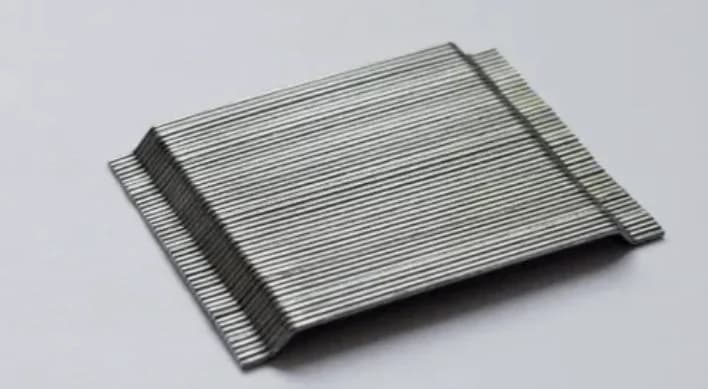
MPZG HT 35/0.55
High-tensile hooked steel fibres with aspect ratio 35/0.55. Maximum anchorage and ductility for heavily loaded structures.
- TypeCold-drawn hooked steel fibre (glued)
- Dimensions35 mm / Ø 0.55 mm
- Tensile strength1345 N/mm² ± 7.5%
- Modulus of elasticity200,000 N/mm²
Pallet price on request