CO₂ Performance Ladder: levels, certification and substantiation with fibres

The CO₂ Performance Ladder in practice: what the five levels involve, how certification via SKAO works, and how to substantiate scope 3 reduction with fibre reinforcement in a traceable way.
The CO₂ Performance Ladder is the Dutch CO₂ management system and procurement instrument, administered by the SKAO foundation. Companies certify at one of five levels; the higher the level, the greater the notional award advantage in tenders from clients such as Rijkswaterstaat and ProRail — rising to around a 10% discount on the tender price. For infrastructure companies, the biggest reduction opportunity lies in scope 3: the materials they purchase.
What is the CO₂ Performance Ladder?
The CO₂ Performance Ladder was developed in 2009 by ProRail and has been administered since 2011 by the Foundation for Climate Friendly Procurement and Business (SKAO). The instrument has two faces. For the certified company it is a management system that enforces structural insight into and reduction of CO₂ emissions — within its own operations (scope 1 and 2) as well as in projects and the supply chain (scope 3). For contracting authorities it is an award criterion: a higher level earns a notional discount on the tender price, so that more sustainable bidders win more often without having to offer the lowest price.
Hundreds of public contracting authorities now use the Ladder in their procurement — alongside Rijkswaterstaat and ProRail, also provinces, water boards and municipalities. For contractors in civil engineering, a Ladder certificate has thus in practice become a precondition for bidding competitively on infrastructure works.
The five levels of the CO₂ Performance Ladder
The Ladder has five levels (also referred to as steps in the documentation). Each level builds on the previous one; certification at level 5 therefore means you also meet all the underlying requirements. In outline:
• Level 1 — qualitative insight into your own energy consumption and largest energy flows.
• Level 2 — quantitative insight into energy consumption, plus a stated reduction ambition.
• Level 3 — a full CO₂ footprint of scope 1 and 2 in accordance with ISO 14064-1, concrete reduction targets, and structural internal and external communication about them.
• Level 4 — additional insight into the material scope 3 emissions of the supply chain, substantiated with chain analyses, plus reduction targets for that chain.
• Level 5 — demonstrable reduction in the chain, public commitment to your own targets and active participation in sector or chain initiatives.
Level 3: the usual entry point
For most SME contractors, level 3 is the practical entry point: it is the lowest level at which contracting authorities generally grant a substantial award advantage, and the requirements remain limited to your own organisation (scope 1 and 2). You map fuel, gas and electricity consumption, set reduction targets and report on them every six months. The administrative burden is manageable: many companies combine it with an existing ISO 9001 or 14001 system.
Levels 4 and 5: the supply chain takes centre stage
At levels 4 and 5 the focus shifts outwards. You analyse where in your supply chain the most CO₂ is released — for construction and infrastructure companies that is almost always the purchased material: concrete, reinforcing steel, asphalt and bitumen — and formulate reduction strategies with evidence that they work. This is exactly where material choices such as fibre reinforcement become relevant: a chain analysis showing how many kilograms of steel or how many degrees of production temperature an alternative saves is directly usable audit material. Large infrastructure contractors that work extensively for Rijkswaterstaat and ProRail are virtually all at level 5.
Certification: SKAO, certification bodies and audits
SKAO administers the certification scheme but does not issue certificates itself. The CO₂ Performance Ladder certificate is issued by an independent, accredited certification body (CB) after an external audit. In broad terms the process runs as follows:
• Draw up the footprint — an emissions inventory of scope 1 and 2 (from level 4 also scope 3) over a representative base year.
• Write a reduction plan — targets, measures and a control cycle for monitoring progress.
• Build the dossier — evidence for each perspective of the Ladder: insight, reduction, transparency and participation.
• External audit — the CB assesses both the dossier and actual practice; this is followed by an annual surveillance audit and recertification every three years.
Allow indicatively (2026 price level, depending on company size and level) for an annual SKAO contribution of several hundred to several thousand euros plus the CB's audit fees; for an SME at level 3 the total usually comes to a few thousand euros per year. That is generally recouped many times over with a single tender won on the strength of the award advantage.
Handbook 4.0: what has changed?
The requirements per level are set out in the CO₂ Performance Ladder Handbook. In 2024, SKAO published Handbook 4.0 as the successor to version 3.1, with a transition period during which certificate holders migrate step by step. The common thread: reduction targets must be more ambitious and better substantiated, in line with the Paris climate agreement, and scope 3 — the supply chain — carries more weight. For contractors this concretely means that material-related measures, such as replacing reinforcing steel with fibres or producing asphalt at a lower temperature, count for more in the dossier than before. For the exact requirements per level, always consult the current handbook version on the SKAO website.
Award advantage: what does a level deliver in tenders?
In tenders based on EMVI/BPKV (best price-quality ratio), your level translates into a notional discount on the tender price: the contracting authority assesses your bid as if it were cheaper, while you invoice the full amount. The percentage varies per authority and per tender, but increases with each level — from around 1% on the lowest levels to a maximum of some 10% at level 5 with large infrastructure clients. On a €2 million contract, level 5 can thus deliver a computational advantage of €200,000 over an uncertified competitor.
The Ladder rewards the company; with instruments such as the environmental cost indicator (MKI) and DuboCalc, the contracting authority rewards the design and the material. In modern infrastructure tenders the two come together: your Ladder level determines the notional discount, and the MKI score of your DuboCalc calculation determines the quality advantage of your design. Whoever can produce figures on both tracks is in the strongest position.
Is the CO₂ Performance Ladder mandatory?
No — there is no legal obligation to hold a Ladder certificate. You may bid without a certificate on tenders in which the Ladder is included as an award criterion; you simply forgo the notional discount and thus start with a price disadvantage that can run to some 10%. Because virtually all major public infrastructure clients now apply the Ladder, certification has in practice become a de facto requirement for civil engineering contractors. Some contracting authorities additionally require a project-level CO₂ management plan from the winning bidder — even without a certificate, you then still have to make your emissions transparent.
Scope 1, 2 and 3: where is the gain?
The Ladder classifies emissions according to the Greenhouse Gas Protocol:
• Scope 1 — direct emissions from your own sources: fuel for plant and vehicle fleet, gas consumption of offices and workshops.
• Scope 2 — indirect emissions from purchased electricity (and heat).
• Scope 3 — all other chain emissions: purchased materials, third-party transport, processing and end of life.
For construction and infrastructure companies, the vast majority of the total footprint usually sits in scope 3, with concrete, reinforcing steel, asphalt and bitumen as the largest items. Electric plant and green electricity reduce scope 1 and 2, but anyone who has to demonstrate chain reduction at level 4 or 5 cannot avoid the material choice itself. That is where fibre reinforcement comes into the picture.
Scope 3 reduction with fibre reinforcement: the figures
Fibre reinforcement of concrete and asphalt delivers project-specific, traceable figures for your Ladder dossier — exactly the kind of substantiation certification bodies and contracting authorities want to see.
Concrete: avoided steel production
If you replace (part of) the traditional reinforcement with fibres, you avoid the production of reinforcing steel — one of the most CO₂-intensive materials in construction. In a documented practical example, the switch to fibre reinforcement resulted in a 98% CO₂ reduction compared with the original steel solution; the full worked example of this CO₂ saving is set out in a separate article. With a synthetic macro fibre such as TwistR for scope 3 reduction in concrete work, the labour-intensive steel-fixing work on site is eliminated as well. Note: fibres do not always fully replace traditional reinforcement — structural work requires a calculation by the structural engineer.
Asphalt: lower production temperature
In asphalt, the gain lies in production. An aramid fibre such as AsphaltX — dosed as a range of around 0.05%, or some 500 grams per tonne of asphalt, depending on mix and application — enables reinforcement with regular penetration grade bitumen instead of polymer modified bitumen (PMB). That delivers two measurable effects:
• A production temperature around 15-20°C lower than with PMB, and thus directly less energy consumption and CO₂ emission at the asphalt plant.
• Better recyclability of the penetration grade bitumen at the end of its life, compared with PMB.
The European FIBRA research programme and Dutch field projects such as the N337 provincial road provide the independent substantiation with which you can include these effects in a chain analysis or project report. If you are bidding on a fibre asphalt tender, also read what to look out for when tendering fibre reinforced asphalt.
How to build the Ladder dossier
Certification bodies and contracting authorities assess measures on substantiation, not intention. "We use sustainable fibre reinforcement" carries little weight; "fibre reinforcement lowered the production temperature by 18°C, saving X litres of fuel per tonne of asphalt" is directly usable. In practical terms:
• For each project, request a specific calculation of the CO₂ saving of the fibre reinforced mix compared with the conventional alternative (PMB or steel reinforcement), preferably based on independent research such as FIBRA.
• Document the avoided quantities — kilograms of steel, litres of fuel from lower production temperatures — so they can be aggregated in your annual footprint report.
• Link the measure explicitly to your scope 3 reduction targets in the reduction plan submitted to the certification body.
• Include the figures in your plan of approach for tenders where the Ladder is an award criterion — concrete and traceable, not generic sustainability claims.
Want to know in advance which figures you can work with? Request the EPD figures for your Ladder dossier via a quotation — per product and dosage, usable in your chain analysis. More articles on standards and sustainability can be found in the pillar Sustainability, Standards and Innovation.
Frequently asked questions
- What is the CO₂ Performance Ladder?
- The CO₂ Performance Ladder is a Dutch CO₂ management system and procurement instrument, administered by the SKAO foundation. Companies are certified by an independent body at one of five levels. Contracting authorities such as Rijkswaterstaat and ProRail reward a higher level with a notional discount on the tender price, so that more sustainable bidders win more often.
- Is the CO₂ Performance Ladder mandatory?
- No, there is no legal obligation. You may bid on tenders without a certificate, but you then forgo the notional award advantage — a price disadvantage that can run to around 10%. Because virtually all major public infrastructure clients apply the Ladder, certification has in practice nevertheless become a de facto requirement for civil engineering contractors.
- What does CO₂ Performance Ladder level 3 involve?
- At level 3 you draw up a full CO₂ footprint of scope 1 and 2 in accordance with ISO 14064-1, formulate concrete reduction targets and communicate about them structurally, both internally and externally. It is the usual entry point for SME contractors: the requirements remain limited to your own organisation and a substantial award advantage is generally already granted.
- What is the difference between level 3 and level 5?
- Level 3 concerns your own organisation: footprint, reduction targets and communication for scope 1 and 2. Level 4 adds insight into scope 3 chain emissions, substantiated with chain analyses. Level 5 requires demonstrable reduction in that chain, public commitment and active participation in sector initiatives. Large infrastructure contractors are virtually all at level 5.
- What does certification on the CO₂ Performance Ladder cost?
- Indicatively (2026 price level): an annual SKAO contribution of several hundred to several thousand euros, depending on company size, plus the audit fees of the certification body. For an SME at level 3 the total usually comes to a few thousand euros per year — generally recouped many times over with a single tender won on the strength of the award advantage.
- How does fibre reinforcement count on the CO₂ Performance Ladder?
- As a scope 3 reduction measure. In concrete, fibre reinforcement avoids the production of reinforcing steel — in a documented case good for a 98% CO₂ reduction. In asphalt, an aramid fibre such as AsphaltX enables a production temperature around 15-20°C lower. Both effects can be calculated per project, making them usable in chain analyses and footprint reports.
Share this article
Products mentioned
 Most chosen
TwistR® GREEN HYBRID
High-performance synthetic macro fibres made from 100% polypropylene. Transforms concrete into a stronger composite material.
- TypeHybrid: twisted monofilament + fibrillating network fibre
- Material100% virgin polypropylene
- Length48 mm
- Dosage2.0 – 6.0 kg/m³
Pallet price on request
AsphaltX®
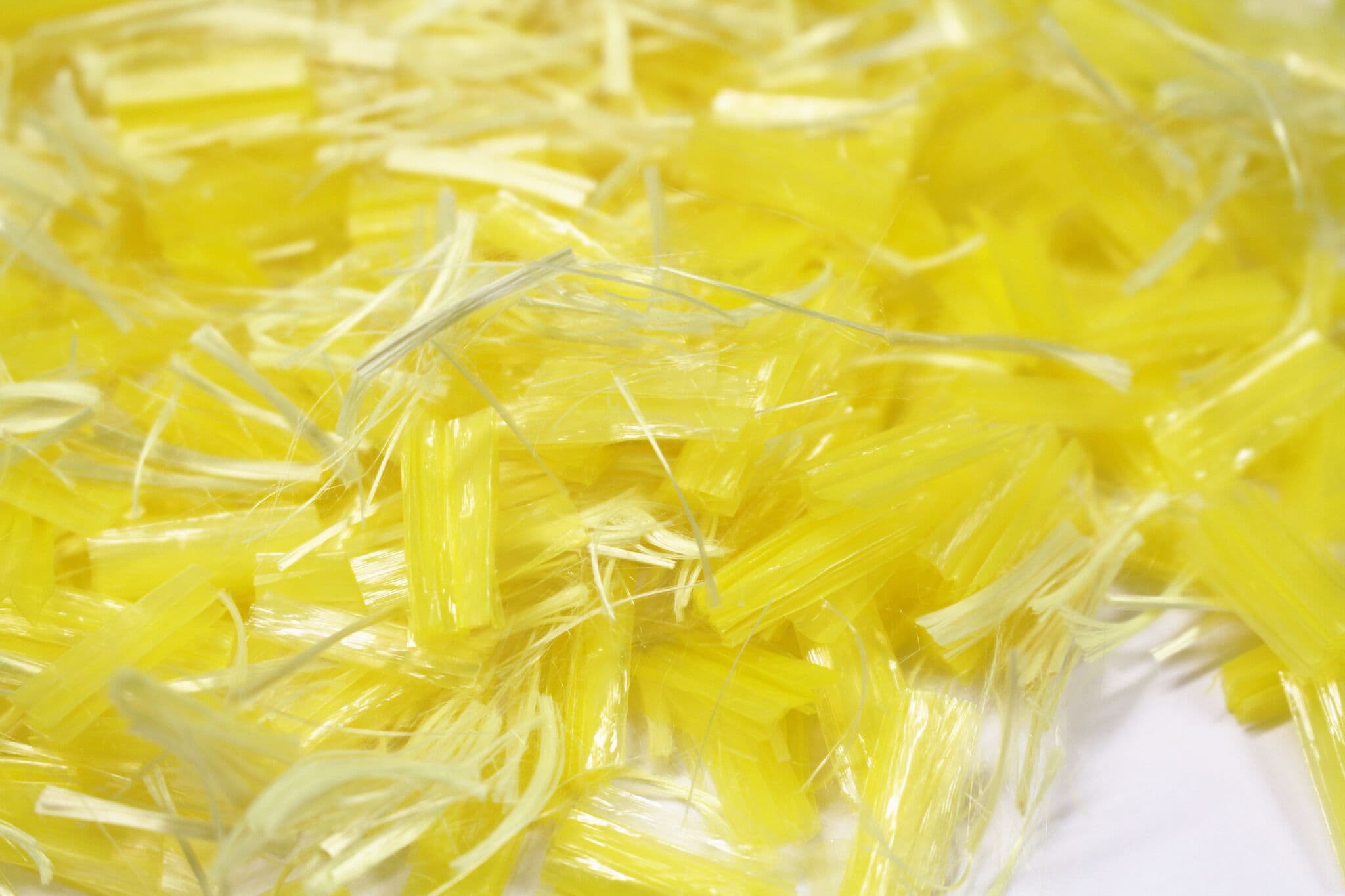
2000 filaments per aramid strand — 19 million fibres per tonne of asphalt. Lowest CO₂ footprint, European manufacturing, proven on the N337.
- TypeAramid (Twaron®) + polyolefin fibre blend
- Length± 19 mm
- Tensile strengthTwaron 3000 MPa · polyolefin 483 MPa
- Specific gravityTwaron 1.45 · polyolefin 0.91 g/cm³